Tag: home care

  • 5 Tips to Prep Your Home for Winter

    5 Tips to Prep Your Home for Winter

    Before winter hits, there are some things you should do to prepare your home and family for the colder weather.

    These 5 tips will guide you through some simple steps any home owner can take. From keeping the pipes from freezing, to removing unneeded clutter, I hope some of these will help you have a more enjoyable winter.

    1. Have your furnace serviced.

    Hiring a professional to service your furnace just before the winter months will ensure you and your family aren’t stuck inside a cold home with a broken heater. If you have a fireplace, this would be a great time to have your chimney cleaned as well. Not only does soot build up create a fire hazard, but animals like to build nests in chimneys as the weather starts to turn – ask me how I know that one! Amazon Home Services is a great place to find qualified pros for any home project.

    2. Clean the outside of your windows.

    Clean windows in the winter can be a mood lifter.

    Winter to some is known as the depression months, and for some people it goes as far as an actual disorder known as SAD. Sunlight can greatly effect our mood for the better.  An easy solution for this, is to open the window blinds. If you’re windows are dirty though, you won’t want to. You most definitely will not want to clean your windows in the snow either. So get out there while the sun is still shining and clean the windows before the snow falls. Now every time you open your curtains this winter you’ll find satisfaction in a clean window, and get a mood lift from the sun. I know it’s cold, but go ahead and open that window for 5 minutes too. The fresh air will change your whole house!

    3. Winterize pipes.

    As a victim of a burst pipe in our first home, I beg you on my hands and knees, winterize those pipes! Make sure the hose is turned off inside the house, not just at the hose. According to this post I found on Winterizing homes from the Comfree blog, you should also drain the hose, and if you’re expecting an extreme cold winter, you can install some Styrofoam insulation at the spigots.

    4. Pack up and store summer clothes.

    You know what I hate? Opening my kids drawers and finding them full of shorts in the dead of winter. If you child is old enough to dress themselves, you most likely will find them trying to wear shorts no matter the weather, or they may just throw them on the floor, mixing them in with the dirty laundry. You can save yourself a lot of extra work, by packing these all in a box, and storing them out of the way until the warm months return.

    5. Know where emergency supplies are. 

    Finally, and I think this is something a lot of people are prone to forget, is have and know where your emergency supplies are. You never know when a winter storm will leave you without power.  A few things you should have on hand

    • flashlights
    • candles
    • matches
    • simple tools. ie, hand wrenches, screwdrivers
    • warm blankets

    I currently keep a bag of these on hand in my car (you never know when you may end up stranded on the road). Although I can easily grab it and bring it inside, it would be best to have an emergency kit inside your house as well. 


  • Keep Mice out!

    Keep Mice out!

    *This post is sponsored by Fresh Cab. All opinions are my own*
     
    There once was a grasshopper who didn’t save food for the winter. When the cold weather set in, he looked to the ants for food and shelter. 
     

    What does that have to do with mice you may ask?  Well, the weather is getting colder, and the mice of the world are looking for someplace warm to hole up for the winter. They will find the holes in your walls, vents, and any other way to get into your house, and storage and make their nest. Mice are NOT FUN!  I kid you not, I have had my fair share plus some, of mice in the house.

    Our first experience was when a mouse died under our fridge. We didn’t know, and it brought ants. Lots of ants. The more I tried to get rid of them, the worse they became (including sprouting wings) until we finally found the mouse. YUCK!

    Last fall we were renting a house next to a huge overgrown field. One morning I woke up and found our cereal boxes chewed through and droppings all over the top of the fridge. From there they escalated. I was still nursing Prince L at the time, with frequent late night feedings.  As I would sit there feeding Lincoln, I could hear the mice scurrying around the walls, and even watched some leap over boxes and come way too close to my feet for comfort.

    One day I was relaxing on the floor with the Princesses during some quiet time, and I literally played peek-a-boo with a mouse around one of the walls. He’d poke his head out, I’d stare daggers and laser-beams – he would duck his head back around, then pop it out again.

    This year I am not taking any chances! We have a storage shed on site, and are renting a storage unit as well while trying to purge our things and fit into 1300sq feet. We have kids clothes stored, my fabric stash, and all our holiday decorations and books. I really don’t want these things to be ruined so I’m taking some precautions, including putting everything into plastic bins, and then using Fresh Cab to detract mice from coming in.

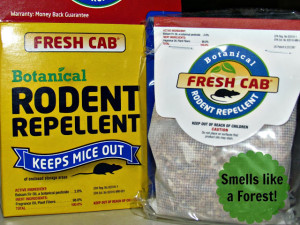
    I am really enjoying the Fresh Cab Botanical Rodent Repellent. It is completely safe to use around kids and animals. Made out of all natural fibers and oils, Fresh Cab repels mice simply by scent.

    The mixture containing Balsam Fir smells so amazing! It’s like walking into a forest. the Balsam Fir is a natural pesticide, which keeps the mice out. Once you can no longer smell the the fragrance, you know it’s time to change the pouch.

    I’ve been using Fresh Cab for about a month now in our storage shed, and have not seen any traces of mice. I hope this keeps up all winter. I’d be happy if I never saw a mouse again.

    What do you do to keep mice out?
  • Organic Pest Control: A Guide for Protecting Your Home and Family This Summer

    Organic Pest Control: A Guide for Protecting Your Home and Family This Summer

    When people think of residential pest control, they often think of exterminators and their toxins. What some don’t realize is that many natural pest control options are available that are safer and more effective than the point-and-spray methods that promise quick fixes (but no long-term results). As you work through your spring and summer cleaning list, incorporate the organic pest control tips that you learn.
     
     
    What is Organic Pest Control?
     
    Residential pest control that’s considered organic or green uses Integrated Pest Management (IPM) techniques. Instead of using dangerous chemicals to repel pests or a generic pesticide to kill them, natural pest control experts:
    • Learn about the behaviors of the pests.
    • Locate nests, remove them and/or block a pest’s access to them.
    • Change the habitat in which the pests live to make them more unfriendly.
    • Use preventive techniques to prevent an infestation or re-infestation.
    • Educate others about pests and prevention.
    In lieu of harsh chemicals, IPM is all about using the most-effective techniques that pose the least risks to humans, animals and the environment. If an expert ever does need to use a chemical application, it’s only as a last resort. He chooses the chemical based on the type of pest and makes sure that
    it’s the least toxic option available.
     
    The Benefits of Natural Pest Control
     
    • Chemical control: Natural pest control doesn’t need dangerous chemicals to be effective.
    • Environmentally friendly: The use of fewer chemicals prevents toxic runoff that can affect your property, the groundwater and the local watershed.
    • Safer for the family: When you use organic pest control, it’s safer for the kids to play outside. Pesticides with toxins can pose numerous health hazards to children, like developmental delays or conditions like attention deficit disorder.
    • Safer for pets: Every year, thousands of pets die from accidental poisonings (like after eating slug bait, for example). Because natural pest control calls for the use of chemicals as a last resort, it’s safer for your pets to be outside.
    • Effective prevention: One of the big goals of IPM is prevention. It’s simpler and less expensive to prevent an infestation than it is to control one. When there is an infestation, implementing preventive techniques will prevent a re-infestation.
    Natural Residential Pest Control Tips
     
    During the summer, fleas, ticks, mites, mosquitoes, ants and flies tend to make an appearance. The good news is that you don’t have to be an expert to practice pest control at your house. Keep following your spring cleaning and regular cleaning checklist, and add the following tips:
    Tame Clutter
    Messes look like heaven to pests because they offer food, materials for a nest or a place to call home. Tackle the piles that you’ve put off for months. Recycle the stacks of paper that you don’t need. Store your seasonal clothes inside plastic boxes with lids instead of cardboard boxes.
    Clean
    Regularly dust, vacuum and clean non-carpeted floors. Pests, like cockroaches, can live off dust particles and crumbs, so this basic cleaning task eliminates a source of food.
    While you’re at it, don’t forget to wash your pets. Bathing and/or brushing your pet can help knock off pests that have hitched a ride in its fur.
    Eliminate Sources of Food
    Homes offer pests a variety of food sources and knowing what they are can help you restrict a pest’s access to them. The following is a list of food sources and solutions:
    • Tables and counter tops: Don’t leave food out in the open.
    • Kitchen sink: Avoid leaving dirty dishes in the sink overnight.
    • Floors, tables and counter tops: Immediately clean crumbs and spills.
    • Garbage cans: Dispose of food waste in outdoor garbage cans instead of under the kitchen sink. Always use the lid on the outdoor trash cans.
    • Pantry and cupboards: Store food that comes with wrappers made of paper or thin plastic, like chips, in hard plastic or glass containers with lids. The same goes for food items in thin cardboard boxes, like cereal. 
    • The garden: Don’t let produce over-ripen or rot.
    • Pet food: Put away pet food after your animal companion eats.
    Landscape Care
     
    Normal landscape care goes a long way toward preventing pests, so weed, mow the lawn and clean debris regularly. Trim back bushes around your home and cut back tree limbs that overhang the roof. Keep your gutters clean and eliminate all sources of standing water. If you have a pool or spa, keep it covered when it’s not in use. Keep the water in a birdbath fresh.
     

    Home Maintenance
     
    Immediately fix leaky pipes. Regularly inspect the exterior of your home for cracks and holes so you can fill them with caulk or putty. If you like to have the windows or doors open during the summer, replace or repair any torn or broken window and door screens.
     
    Residential pest control is a task that’s simple to incorporate into your regular cleaning routine. If you have a pest infestation in your home, or think that you do, don’t hesitate to call a pest control expert that uses natural techniques. 
     
    Looking to prevent pests during the winter? Watch this.


    Author Bio: This post was contributed by Jen McCauley, the marketing director of Western Exterminator. Western Exterminator is a leading integrated pest management company in Western Washington and Oregon that offers green pest control solutions and advice for both residential and commercial customers.