Tag: storage

  • Everything You Need for Home Canned Pears

    Everything You Need for Home Canned Pears

     
    It’s time to store some fruit for the winter. OK, we’re in the 21st century, but if you’ve never canned anything before, I think you’re missing out. Canned pears are one of my utmost favorite home canned products. This post contains affiliate links and I will be compensated if you click on and make a purchase through them. 
     
    The first time I canned pears on my own was 6 years ago when I ordered 40lbs of Pears from The Pear Guy through our church. I was very excited to be preserving so much fruit for my kids to enjoy just as I did at their age. I had NEVER canned on my own before and was very nervous about it. 
    I still get nervous before starting a canning project, but I’ve done it so often now, it’s just about diving right in. 
     

    Home Canned Pears Tips

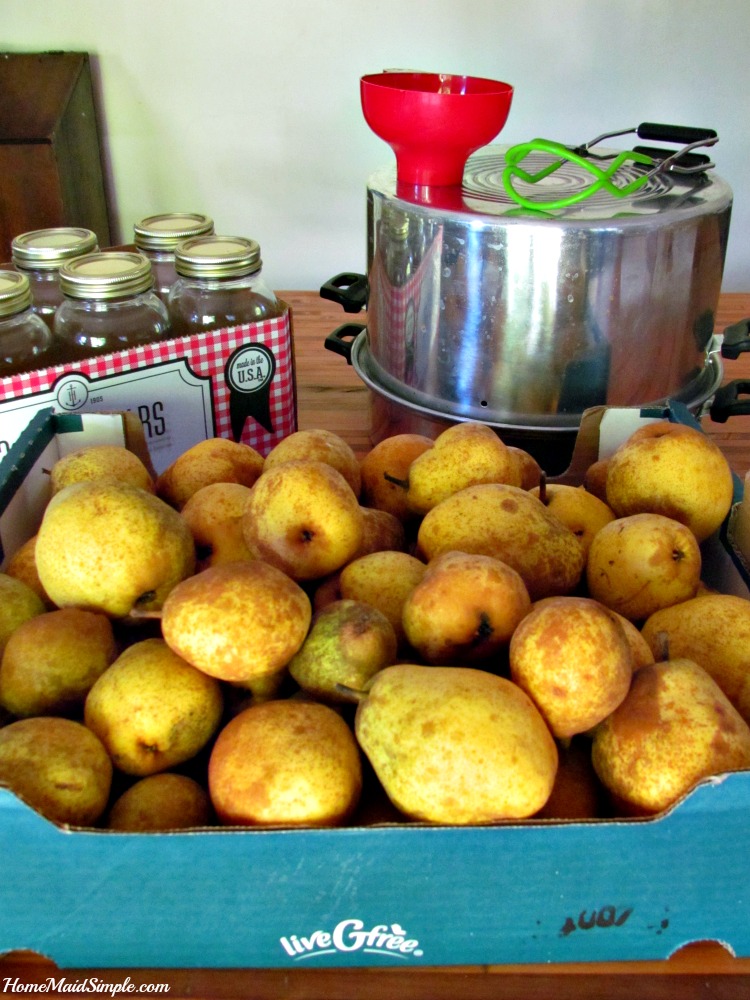
    Before starting you’ll want to gather your equipment. If you’re first starting out, it may seem kind of pricey, and not worth the effort, but most of these things you only have to buy once. 
    • 40lbs Pears
    • 7-8 Quart canning jars and lids
    • paring knife
    • water bath canner
    • Jar lifter
    • wide mouth funnel
    • sugar
    • water


    Once you have everything ready, you’ll want to prepare your syrup. I like to use a light syrup because quite frankly I have a sweet tooth. However, you can also can the pears in fruit juice. If you choose the juice method I would stick with 100% Pear Juice.  

    For this many pears, I make a double batch of syrup. Heat 18cups water and 4 1/2 cups sugar on the stove. Depending on your pot, you may need to do this in 2 batches. 

    While the syrup is heating, go ahead and prepare the jars. You’ll want them washed and sanitized. To sanitize my jars, I prefer using the oven. Set it to 250 F. Place the jars and rings – not the rubber lids – in a pan and set in the oven. They need at least 20 minutes in the oven, but you can leave them longer as you prepare the fruit. 
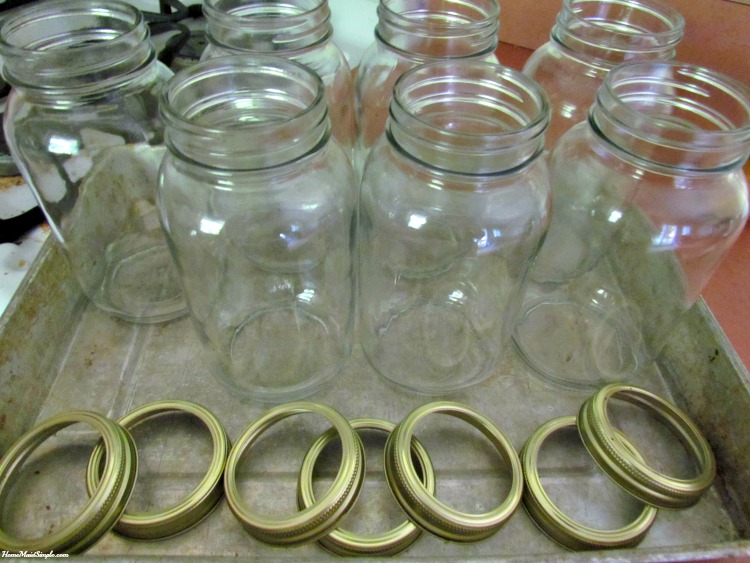
    For home canned pears, sanitize jars and rings in the oven at 250 F for 20 minutes.  

    The prep work is done, and it’s time to get started on the pears. You’ll want to wash, peel, and core your fruit. My favorite way to get the most fruit, is by blanching the pears in boiling water for about 30seconds to 1 minute, then dipping them in an ice bath. The peels come off fairly easily at this point with a paring knife. The downside is that the pears get a bit more soft from the boiling water. So you can always just take a knife and peel and core your pears as if you were going to eat them right then. 

    Once the pears are peeled, and sliced place them in a bowl with some lemon juice to avoid browning. Pick Your Own has some more tips on keeping the fruit from browning while preparing the rest of the fruit. This is the point where it’s also nice to have someone helping. The more hands, the less time the fruit it sitting out and turning brown.  

    Now I dry pack my pears, but you can also hot pack them which is the recommended way.  To dry pack – also known as raw pack – you stuff the cold pears into the hot jars. Once they are full pour in your syrup leaving about a 1/2 inch at the top. Slide a butter knife down the side of the jar and press on the pears to release any trapped air. I’ve always done it this way and never had any issues with spoilage.

    Boil a small pot of water for your canning lids. Once the pears and syrup are in the jar, wipe off the rims with a clean damp cloth. Then you’ll dip the lid into the hot water before placing on the jar. Screw on the rings, finger tight, and prepare to process them. 

    Canned Pears packed in quart should be processed in a water bath canner for 25 minutes. When done, remove the jars from the canner with your nifty jar grabber, and place on a towel to cool. You may start hearing popping sounds – this is the sweet sweet sound of each jar sealing. Give them a day to cool, then press on the lids. If they did not seal there will be a little bubble you can press on. Any unsealed jars should be immediately placed in the fridge and used over the next few days. 

    Correctly sealed jars can be placed in your pantry or food storage and should be used over the next year.  

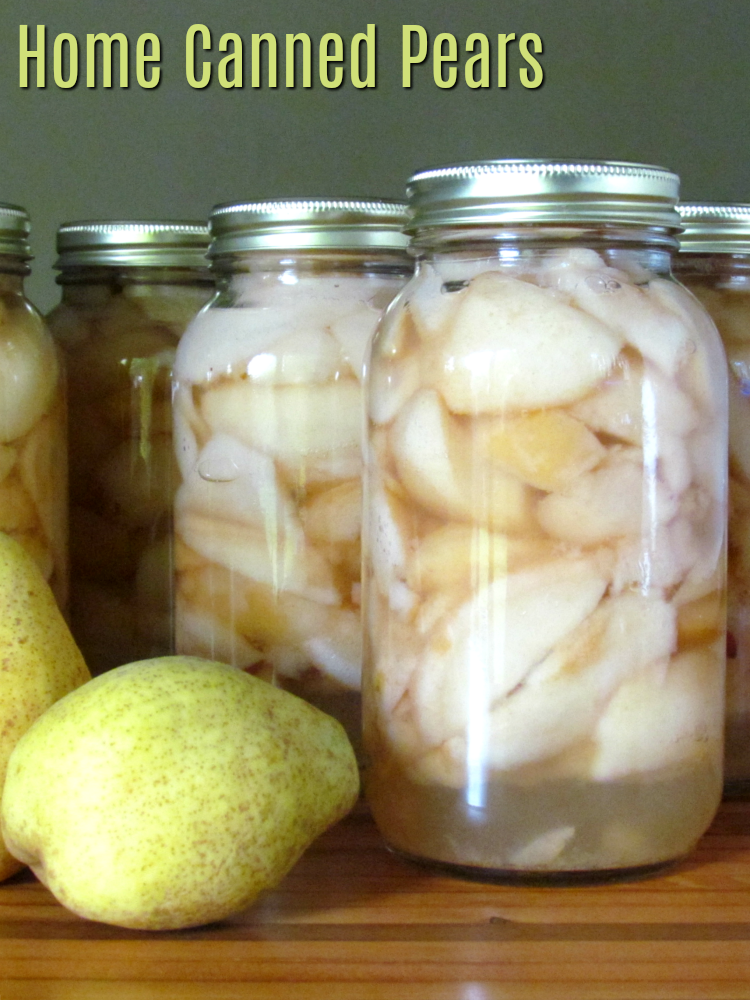
    Home Canned Pears
    Yields 7
    Enjoy the crisp flavor of pears all year with this easy to follow recipe for canned pears.
    Write a review
    Print
    Ingredients
    1. 40lbs Pears
    2. 18 cups Water
    3. 4 1/2 cups Sugar
    4. 8 quart jars and lids
    5. water bath canner
    Instructions
    1. Preheat oven to 250F.
    2. Place jars and rings (not lids) on a pan, and sanitize in oven for 20 minutes.
    3. Combine water and sugar in a pan over medium heat to dissolve sugar. Turn heat to low and let simmer while you prepare the pears.
    4. Wash, peel, and core pears.
    5. Stuff pears into hot jars. Pour hot syrup over pears, leaving 1/2 inch from the jar rim.
    6. Wipe rims with a clean damp cloth.
    7. Dip lids into boiling water, and then place on jars.
    8. Screw rings on to finger tightness.
    9. Process in a water bath canner for 25 minutes.
    10. Remove to a towel, and let cool for 24 hours.
    11. Store sealed jars in a cool dark place. Unsealed jars should be eaten withint the next few days.
    Home Maid Simple https://www.homemaidsimple.com/

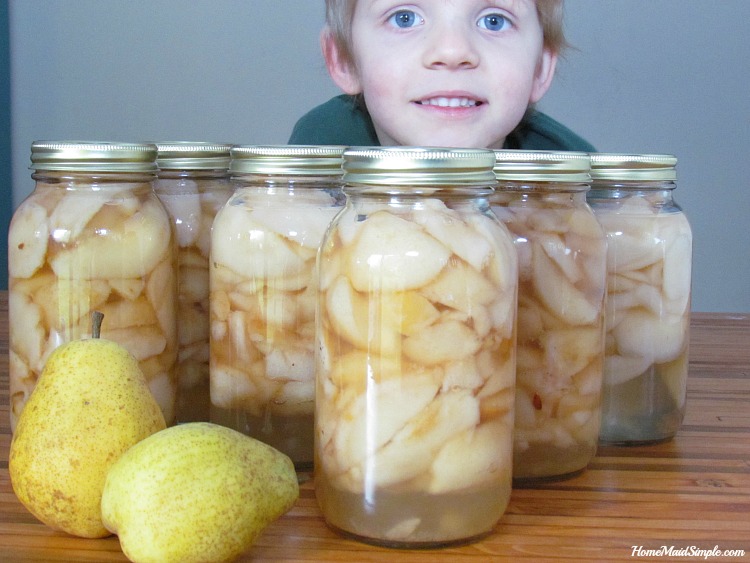
    kids love home canned pears!

    Kids love these! While they will keep for a year in the pantry, my kids usually have them gone within 2 months. 

  • Stress Free Moving {Guest Post}

    Stress Free Moving {Guest Post}

    I need to remember this advice when we begin moving again in the next couple of weeks. Hopefully, especially with the holidays upon us, I can stay as stress free as possible while we settle into our new home!

    Staying Sane While Moving Between Homes

    Moving is exciting, but it’s also rather stressful. People tend to become so overwhelmed during the move that they just feel immense amounts of pressure and anxiety. Follow these tips to have a less stressful move this time around.

    Take Time Off

    Try to plan the move, if possible, for a fairly low key time at work, and then take a few days off. You’ll likely want to take off at least a day or two before the move, the day of the move and possibly the day after as well. You’re going to need this time to pack up, organize and just deal with the general steps of moving.

    Make Lists

    You might be paranoid that the movers are going to lose some of your beloved items, so keep accurate and detailed lists to maintain control. Mark each of the boxes, and note as they make their way through the doors and into the moving truck. Once you’ve arrived in your new home, check the items off of the list to denote that they have arrived.

    Use Storage Units

    Sometimes, it’s not possible to move directly from one house into another. The house might not be ready yet, or the sellers are not ready to move out of the space for another month. In that case, you’ll need to rent for a while or spend some time living with your family. Now, where are all of your items going to go during this transitional phase? Instead of cramming them all into a space that’s too small, simply rent a storage unit, like Dallas Texas Self Storage, for the time being.

    Children and Pets

    Two of your biggest worries are likely going to be your children and pets during the move. If possible, board your pets for the day, so they aren’t able to get out. When that’s not an option, keep them in a separate room while the doors are opening. For small children, hire a babysitter or ask a family member to help for the day.

    Generous Time Limits

    If you insist that the job must be completed within a few hours and that all of your items must be unpacked that very night, then you’re really going to stress yourself out. Remember, moving is a process, and it will likely take several days or even weeks to be settled in your new house.
    Whenever the anxiety and stress creep up, remember that it will be worth it once everything is done and finished.

    Author Bio:
    Melisa Cammack is a busy mother of three young boys (with one little girl on the way), wife to one handsome man, and a freelance writer who loves writing health, travel, parenting and self-help articles. Though she is originally from Seattle, Melisa is currently living in Western Australia with her little family for the next few months due to her husband’s job, and is looking forward to going back to the States in December for a white Christmas, but is already dreading the 30+ hour flight.

  • One copper vase – Many uses

    One copper vase – Many uses

    To be honest I don’t even know what to call this particular item. It’s had many uses in our home. It’s a piece that I love. If you’ve been around here awhile, you may remember when I picked it up. It was about 1 year ago, at a yard sale, for about 50 cents!  What a steal!!

    Originally I used it as a flower vase. We had so many beautiful Irises, and I just love having fresh flowers in the house. Once winter hit though, there were no more flowers going in it, and it sat empty.
    My design process-ees started going, and it ended up as a very stylish bathroom trash can.
    (I won’t share a picture of that….)
     
    With our recent move, it has once again served another purpose
    kids umbrella holder! I love how easy it is now for the kids to come in and place wet umbrellas in this “vase”. It keeps the drips off the carpet, and they always know where their umbrella is.
    We love playing in the rain, so this has been quite the helpful home made storage.
  • Guest Post – DeJunk Your Household

    De-Junk Your
    Household

    So you’re finally deciding to take
    stock of your household objects and see just what you need to keep around and
    what to get rid of? This can be a quite daunting task, but don’t fret! By using
    a few simple tips you can make the process of evaluating your household objects
    and deciding what to do with them quick and painless.

    The first step is to take an inventory of what you’ve actually got. Go through
    your house (yes, even the boxes stacked in the corner of your basement) and
    make a note of every item you find that you could conceivably get rid of. If
    the idea of living without the item even crosses your mind, write it down; you
    will make the final decisions later.

    Once you’ve got your list, it’s time for the hard part. Go down the list and
    take a good hard look at each entry. How old is the item, and how often has it
    been used? If it’s something that you haven’t even thought about for five
    years, you’re looking at a great opportunity to simplify your life by getting
    rid of it. If the object has significant sentimental value and you can’t even
    bear to imagine losing it, go ahead and keep it around. Be careful not to use
    this excuse lightly, though.

    If the item in question is something that is only used occasionally such as
    seasonal decorations or clothing, consider placing it in storage. This way you
    remove it as clutter from your household while still having full access to it
    when the appropriate time comes.

    Now that you’ve got a trimmed down list of what you’re considering getting rid
    of, it’s time to decide just what to do with all of it. For items such as old
    clothing, bedding and toys, donating to a local or national charity is always
    an attractive option; the items will be put to good use, and you can usually
    write the donation off on your taxes. Items that have retained value such as
    furniture and electronics, do some research to find out a fair price and put it
    up for sale. There’s no better feeling than reducing clutter and earning money
    while doing it! And if it’s truly trash, just throw it out; you won’t miss it.

    With these simple tips, it’s easy to reduce clutter in your house and simplify
    your life. You may even make a few extra bucks, to boot!

    Casey Haslem is a writer and paints in her spare time. She
    writes often about storage and organization. If you’re in need of help with
    storage, contact
    Sam Dimas
    self storage units
    or Brooklyn
    Extra Space Storage
    .
  • Tuesday Tip – Battery Storage.

    With the recent holidays, many of us will find our counters spilling over with batteries.  The problem we always seem to run into is finding the right size battery, and then wondering whether it has enough juice or not. I know we have a bad habit of taking out old batteries but never disposing of them. 
    In my recent attempts to get a variety of holiday pictures, I went through many batteries. Some worked for a few minutes, others wouldn’t even turn my camera on. It was extremely frustrating, so I just bought more batteries. This time I decided to store them better.

    Source: bhg.com via Adelina on Pinterest

    I love bhg’s idea of a tackle box. Having the separate compartments for each size makes that look so nice! I took a cheaper route though, and used a pencil box I already had on hand. It doesn’t have the separate compartments, but it closes, and keeps the batteries contained.   Now whenever I need a battery I know just where to look.  And if it’s not in there, I know I need to buy more.

    While I’m on the topic of batteries, with a New Year drawing close, may I suggest you check your smoke detectors and carbon monoxide detectors. Starting the new year with fresh batteries will help keep your home and family safe. Once I’ve hit post here, I’m off to add some brand new 9volts to our smoke detectors. 

    I’m linking up with Confessions of a Frugal Mind